Learn how personalized player fundraising links drive more donations, boost accountability, and help sports teams hit their goals faster.
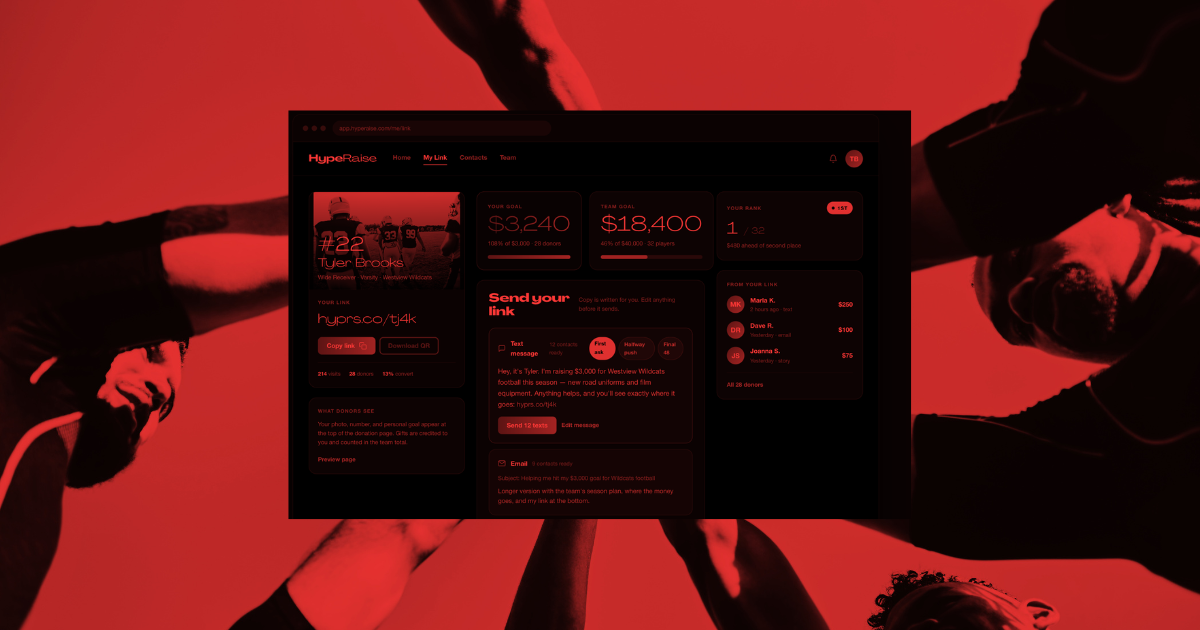
Most sports fundraisers treat every player the same. One campaign page, one shared link, one message that goes to everyone. The result? Donors click through, see a generic team page, and feel zero personal connection to what they’re supporting.
Personalized player links fix that. When each athlete has their own fundraising URL tied to their name, their photo, and their personal ask, the whole campaign shifts from a transaction into a story. Donors give more, and they give faster.
Here’s how it works, why it works, and exactly how to set it up.
A personalized player link is a unique fundraising URL assigned to each individual athlete on your roster. Instead of sharing one generic campaign page, every player gets their own page that shows:
When a player shares that link with family and friends, every donation made through it is credited directly to them. The coach and program see total campaign progress, but the player’s individual impact is visible and trackable.
This structure isn’t a gimmick. It’s one of the most reliable ways to drive higher average donations and broader reach across your contact list.
People give to people, not programs.
When Grandma gets a text from her granddaughter with a link that says “Help me reach my goal of $300 for the lacrosse season,” she’s not thinking about the program’s budget. She’s thinking about her granddaughter. That personal connection is worth more than any clever campaign headline.
A few patterns hold up across hundreds of campaigns:
The accountability factor matters too. When a player can see their own number (say, $175 of their $400 goal), they’re far more likely to send a follow-up message than if their contributions are buried in a team total.
The setup process is faster than most coaches expect. With a platform like HypeRaise, it takes about an hour to go from roster upload to live, individual player pages.
Start with a simple spreadsheet. You need at minimum:
Don’t overthink this step. Export your existing roster from whatever system you use (or build it in Google Sheets), clean up the columns, and you’re ready to upload.
Once your contact list is uploaded, the platform generates a unique page for each player automatically. You can either:
Per-player goals work better than a single team total for one reason: they give players something concrete to aim for. “Help the team raise $10,000” is abstract. “Help me hit $350 before Friday” is actionable.
Most platforms that support personalized links will auto-populate the page with the player’s name and basic campaign info. What you add on top of that is what makes it convert:
If you’re running a program with 50+ players, you don’t need a custom message from every single athlete. A solid template that coaches personalize with the player’s name and position goes a long way.
Giving players a personal link isn’t enough. They need a low-friction way to share it.
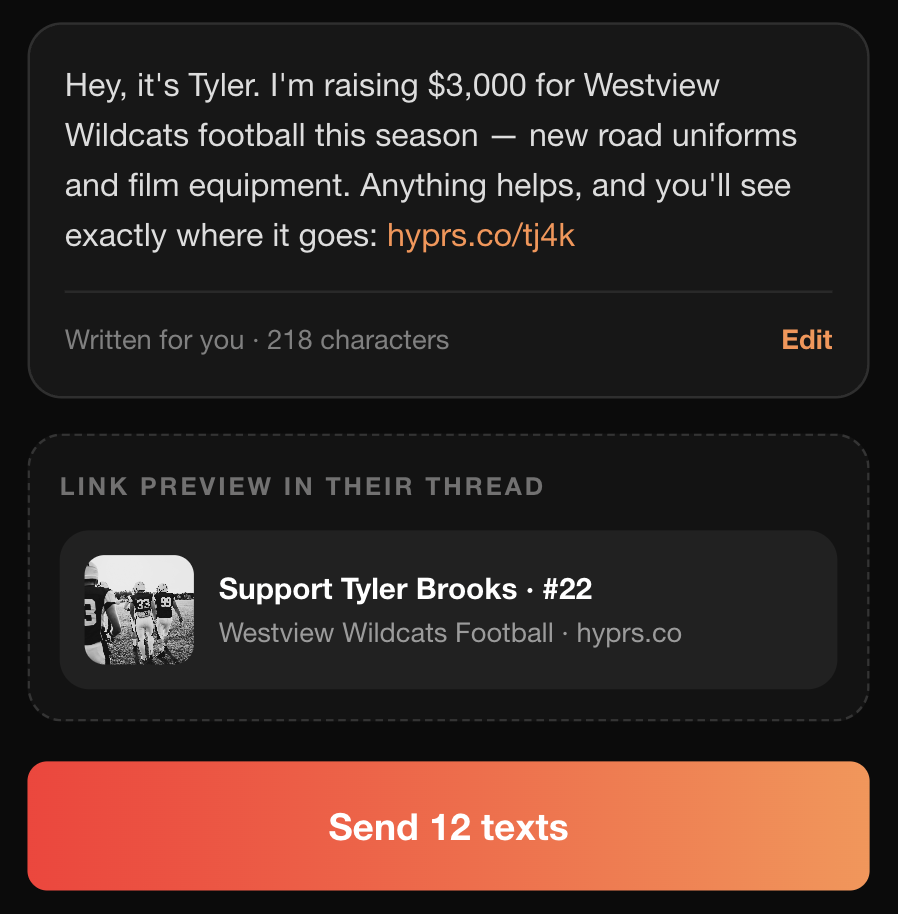
Write a simple text template they can copy and send:
“Hey [Name], I’m doing a fundraiser for [Team] this season. Would you be willing to donate? Here’s my personal link: [URL]. Even $25 makes a huge difference. Thanks!”
Send that script via team app, group chat, or email. Some coaches make it a practice: every player sends 10 messages on launch day. That alone can generate a significant first-day spike.
Real-time dashboards are what make personalized links genuinely useful for coaches. You can see at a glance:
That data lets you do targeted follow-up instead of blasting the whole team with reminders. If 8 out of 22 players haven’t shared their link by day 3, you talk to those 8. You don’t bother the other 14 who are already performing.
HypeRaise’s real-time dashboard is built exactly for this use case: coaches see per-player performance, athletic directors see multi-team rollups, and parents and donors see only what’s relevant to the player they care about.
Skipping the personal message. A player link with just a name and a donate button performs significantly worse than one with even a short personal note. Don’t launch bare pages.
Setting goals too high. A $1,000 individual goal can feel paralyzing. Most players won’t even try if the number looks impossible. Start at a goal the player can realistically hit with 8 to 12 donor conversations. For most youth programs, that’s $250 to $500.
Not following up. Personalized links don’t run themselves. Players need 1 or 2 nudges during the campaign to keep momentum going. Build follow-up reminders into your campaign timeline from the start.
Using the wrong primary contact. The player link goes furthest when it’s shared by the parent, not just the player. Parents have broader adult networks (colleagues, neighbors, extended family) who are more likely to give. Make sure parent email addresses are in your contact list.
The sweet spot is 2 to 3 weeks. Long enough to allow for multiple outreach touchpoints, short enough to maintain urgency.
A typical campaign calendar looks like this:
Shorter than 2 weeks and you don’t have time to follow up properly. Longer than 3 weeks and donor attention fades.
No. On most platforms, the coach or campaign admin creates all player pages through a single upload. Players receive their unique link automatically. They don’t need to log in or configure anything. The less friction there is for players, the more likely they are to share.
It happens, and it’s fine. You can exclude individual players from the campaign during setup, or simply not assign them a link. For players who opt out, just make sure you’re not sending automated outreach to contacts associated with their account.
Yes, and it’s actually a smart approach. Running fall and spring campaigns (or even a mid-season push) with fresh player links keeps your contact list engaged without burning it out. Just give donors enough time between campaigns, typically 3 to 4 months, to avoid fatigue.
Donations are credited to the campaign, not the individual athlete. If a player leaves after the campaign launches, their donations still count toward your program’s total. You can typically reassign or archive their page through the platform dashboard.
The easiest method is text message to individual contacts, not a mass social media post. Text converts at a significantly higher rate than social sharing for this type of fundraiser. Coach players (and their parents) to send personalized texts to people they actually know rather than posting a generic link on Facebook and hoping for clicks.
HypeRaise handles the full personalized link setup for every team that runs a campaign with us. Upload your roster, set your goals, and every player has a live fundraising page in under an hour. Learn more at HypeRaise.com.
HypeRaise gives coaches, boosters and parent volunteers the tools to run a centralized, transparent, and effective campaign.
Get Started